How Qurbani Creates Hope for Families
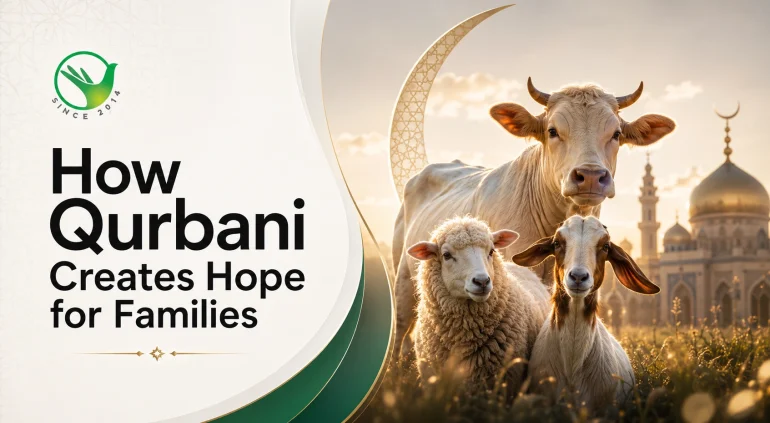
The World Food Programme reports that 82 percent of Pakistan’s population cannot afford a nutritious diet. The Global Hunger Index ranks Pakistan 106th in the world. These figures represent real families, in real homes, who face Eid al-Adha with empty kitchens and children who have learned not to ask for what they cannot have. Qurbani changes this. Not in abstract terms, but in concrete ones. A package of fresh meat arriving at a widow’s home on the morning of Eid al-Adha is not a statistic. It makes a real difference in people’s lives. This is the human story behind Qurbani, and it is the reason this obligation carries so much weight in both Islamic law and Islamic conscience.
Who Is Waiting for Your Qurbani
The families who benefit most from Qurbani distributions are largely invisible from the outside. They do not live on main roads or in neighborhoods that donors pass through. They live in slum settlements without proper infrastructure, in rural districts hours from the nearest market, and in institutions that the public rarely visits.
A widow raising three children on irregular daily wages does not have the means to buy meat at market prices. A laborer who has migrated seasonally for work sends everything home and survives on whatever the worksite provides. An elderly man with no family living in a nursing home shares whatever the facility allocates, which is often inadequate.
The Quran instructs believers to seek out these people:
That they may witness benefits for themselves and mention the name of Allah on known days over what He has provided for them of [sacrificial] animals. So eat of them and feed the miserable and poor. (Surat Al-Haj, 22:28)
The “miserable” or “poor” in this verse is not someone who approaches your door. It is the person who cannot approach any door because they do not know where to turn. Qurbani, through a well-organized charity, reaches them.
The Moment the Meat Arrives
The distribution of Qurbani meat is not just a logistical event. For the families receiving it, it marks a rare moment of participation in the celebration of Eid. Children who have watched others celebrate the festival from a distance are suddenly included. A family that would otherwise spend Eid al-Adha like any other difficult day receives a package that says, in the most tangible way possible: someone remembered you.
The Prophet (ﷺ) articulated the bond that should hold Muslims together in these precise terms:
“Nu’man b. Bashir reported that Muslims are like one body of a person; if the eye is sore, the whole body aches, and if the head aches, the whole body aches.” (Sahih Muslim, 2586d)
When Qurbani meat reaches a family in need, that bond is made real. The donor, wherever they are, has shared something of their blessing with a stranger who had no one else to turn to.
The Ripple Effect of a Single Donation
The impact of one Qurbani donation extends beyond the moment of distribution. A family that eats well on Eid al-Adha enters the following days with more physical strength, more emotional resilience, and the knowledge that their community has not abandoned them.
For children, especially, a protein-rich meal during Eid contributes to physical health in the short term. But the psychological dimension, the experience of being included rather than excluded, carries longer through a child’s memory and sense of self.
The Quran connects this kind of giving to the highest level of spiritual attainment:
“Never will you attain the good [reward] until you spend [in the way of Allah ] from that which you love. And whatever you spend – indeed, Allah is Knowing of it” (Surat ‘Āli `Imrān, 3:92)
A Muslim who donates Qurbani for the benefit of families who have nothing is spending from something they love for the sake of something far greater.
Donate Your Qurbani to Transparent Hands This Eid al-Adha
Transparent Hands has established itself as one of Pakistan’s most trusted online healthcare crowdfunding platforms, supporting thousands of underprivileged patients across the country. Alongside that mission, we run a fully Shariah-compliant Qurbani program carried out with sincerity, transparency, and meticulous care. In our earlier Qurbani campaigns,we made sure that the sacrificial meat reached the most vulnerable people, including transgender communities, families living in slums, daily-wage laborers, madrassa students, and elderly residents of old-age homes. With your generous support this Eid al-Adha, we can extend that blessing to even more deserving families. Donate your Qurbani (Fi Sabilillah) with Transparent Hands today!
FAQs
Does the family know who donated the Qurbani meat they received?
Typically, the distribution is anonymous. The donor’s name is not shared with the family receiving the meat. This aligns with the Islamic teaching that the most valued charity is that which is given quietly, without expectation of recognition.
How many families does a single Qurbani donation reach?
This depends on the animal and the size of the distribution package. A single goat or sheep can provide meat packages for multiple families. A cow share provides significantly more meat and can reach a greater number of households.
What is the emotional impact of receiving Qurbani on Eid al-Adha?
For families living in poverty, the arrival of fresh meat on Eid is a powerful reminder that they are not forgotten. Across communities served by Qurbani charities, beneficiaries consistently describe the experience as one of joy, dignity, and a sense of belonging to a larger community.



Leave Your Comments