How to Identify Scabies and Treat It Effectively
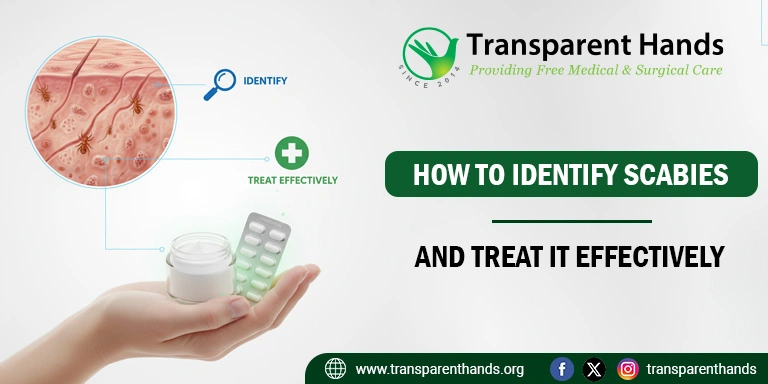
According to the World Health Organization (WHO), nearly 200 million people suffer from scabies across the globe at any one time. Scabies is prevalent around the world, but it is most common in tropical countries and regions with hot climates.
It’s estimated that the condition can affect more than 400 million people cumulatively annually. The alarming prevalence of scabies is affecting healthcare systems globally, with many people unable to access effective treatments to overcome their suffering.
This article will help you understand how to identify scabies by exploring various symptoms of scabies. We’ll also share insights into how scabies can be stopped from spreading and treated properly, especially in low-income areas.
Heal Lives with Free Healthcare Services
What is Scabies?
Scabies is a skin condition caused by mites that enter the skin and lay eggs, which eventually leads to unbearable itching and rashes. Sarcoptes scabiei var hominis causes human scabies, a parasitic infestation.
Intense itching occurs in those areas where the mites have burrowed. Its rashes usually occur around the skin between fingers, under the arms, wrists, and waist.
Scabies causes discolored rashes due to which there is intense itching. Some cases of scabies may even lead to widespread superadded bacterial skin infections which may lead to kidney disease and chronic renal failure.
How to Identify Scabies and What Are Its Symptoms?
The eight-legged mites are microscopic. Hence, it is not possible to detect the mites through the naked eye. Although you cannot see the mites, your body still sends signals in the form of inflammatory reactions such as rashes and intense itching. While learning about how to identify scabies, these common symptoms need to be taken into account.
In adults and seniors, the appearance of a rash is usually one of the first symptoms of scabies. This rash looks like red tiny bumps similar to small insect bites. In the case of infants, the symptoms of scabies may include tiny fluid-filled blisters.
The most usual scabies symptoms are intense itching (pruritus), mainly at night, and a pimple-like (papular) rash. If you never had scabies before, then it takes 3-6 weeks for the symptoms to appear, whereas those who have experienced this condition before may observe the symptoms from 1-4 weeks.
Eradicate Diseases by Donating to Transparent Hands
What Are the Causes of Scabies and How Does It Spread?
Now that we know how to identify scabies, let’s explore its causes and ways of spreading. Scabies is caused by the human itch mite which is 0.2 mm to 0.4 mm long. The female mite lays its eggs after burrowing under the skin. When these eggs hatch, the larvae that come out of it spread and move to the skin’s surface.
These larvae move around and can burrow into various parts of the body or even move to another host through physical contact. This is a highly contagious condition and spreads through physical contact.
Scabies are usually transmitted through direct skin-to-skin contact. People who have scabies can be infectious even when the symptoms have not occurred.
Scabies Treatment and How to Prevent It?
Scabies treatment should only begin when the diagnosis has been confirmed by a doctor. This is especially important for pregnant women, infants, and people suffering from other health conditions. To identify scabies and confirm the diagnosis, you often have to submit a sample of your skin.
Join Us in Bringing Free Treatments to Low-Income Communities
To kill the mites and eggs, use creams and different medications as prescribed by your doctor. Scabies treatment includes:
- Permethrin cream is a skin cream formulated to kill mites and their eggs.
- It’s recommended that those with scabies should apply Sulfur cream overnight and then rinse it off well.
- Ivermectin (Stromectol) is a pill to treat scabies. It’s usually prescribed to those who have low levels of immunity and crusted scabies. However, it isn’t recommended for women who are pregnant or breastfeeding and babies who weigh less than 15 kg.
Preventative measures include avoiding physical contact, washing bedsheets, and clothing materials, getting other family members treated as well, isolating the infected person, and eating a healthy diet.
How Transparent Hands Fights Scabies in Pakistan
Symptoms of scabies are reported from various parts of Pakistan, including KPK. According to the Journal of Pakistan Association of Dermatologists, people aged 21-50 in Khyber Pakhtunkhwa face a high prevalence of scabies. This itchy skin condition spreads fast but can be prevented and treated with proper care.
Transparent Hands is working on the frontlines, organizing free medical camps in communities where scabies is common. Our medical experts know how to identify scabies. We not only provide free check-ups, help identify scabies, and distribute medications for it, but we also hold preventive healthcare sessions to raise awareness about this condition. With these steps, we’re playing a key role in eradicating scabies from Pakistan’s low-income, rural, and vulnerable communities. Play your part in making this world a healthier place. Support Transparent Hands’ life-changing initiatives today.





Leave Your Comments