Who is Eligible for Sadaqah in Islam
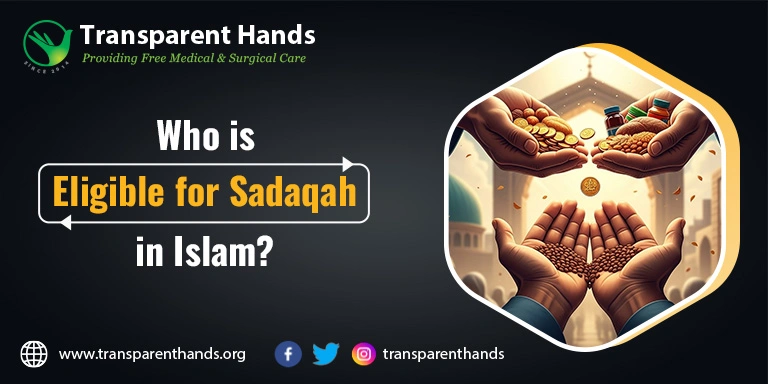
Giving charity is one of the most fundamental requirements for practising Islam. While Zakat is the mandatory form of giving in Islam, Sadaqah has a special place in Islam, which is reserved for believers willing to spend money in Allah’s (SWT) ‘s path without any desire for rewards.
The concept of Sadaqah isn’t limited to financial giving; it extends to everyday behaviors that benefit our fellow human beings. In this article, we will discuss the meaning of Sadaqah, its place in an Islamic society, and who is eligible for Sadaqah in Islam.
What is Sadaqah?
Sadaqah is charity that is given with the purest intention and without any urge for rewards. While Sadaqah is mostly voluntary, Sadaqah Wajiba is a binding form of Sadaqah, which is mandatory. Sadaqah Wajiba includes Zakat, Sadaqah Fitr, Nadhr, Fidya, Kaffarah, and Udhiyyah. However, in this article, we will mostly refer to the voluntary form of Sadaqah.
The most fundamental part of the Islamic faith is the belief in the world’s temporary nature. Believers don’t only verbally confess that the world is a transient place, but also back up that belief with their daily behavior. This world is a place of trial, and our deeds, actions, and choices will decide our fate in the afterlife, which is permanent and lasting. The Quran clearly states that reality in the following verse:
“[He] who created death and life to test you [as to] which of you is best in deed – and He is the Exalted in Might, the Forgiving” (Surat Al-Mulk, 67:2)
Therefore, believers must try their best to prepare themselves for the afterlife. For Muslims, the Quran paves the way to eternal salvation:
“O you who have believed, enter into Islam completely [and perfectly] and do not follow the footsteps of Satan. Indeed, he is to you a clear enemy.” (Surat Al-Baqarah, 2:208)
The stress on ‘entering Islam completely’ refers to submitting to Allah (SWT) completely and without any questions. Therefore, Islam just doesn’t demand adherence to a few rituals, but a lasting change in an individual’s morality that affects not only the person, but the entire society.
That’s why Sadaqah isn’t reserved for financial help only. You can even practice Sadaqah by engaging in simple, yet powerful, acts of good behavior, such as smiling at people.
Types of Sadaqah
Sadaqah is of two types: Monetary and Nonmonetary. Monetary Sadaqah is a financial contribution you can make to help someone. These contributions may take the form of cash, food, medical aid, or other forms of assistance. However, the spiritual blessings of Sadaqah are not only reserved for those who can spend. Believers with exemplary behavior also partake in Sadaqah. According to a Hadith:
“Every joint of a person must perform a charity each day that the sun rises: to judge justly between two people is a charity. To help a man with his mount, lifting him onto it or hoisting up his belongings onto it, is a charity. And the good word is a charity. And every step that you take towards the prayer is a charity, and removing a harmful object from the road is a charity.” [Al-Bukhari] [Muslim] Hadith 26, 40 Hadith an-Nawawi
Who is Eligible for Sadaqah?
While the Quran categorically defines eight categories of people who can qualify for Zakat, Sadaqah has a much broader eligibility. Sadaqah can be given to the poor, needy, indebted, and even to non-Muslims in need. In fact, there is a special kind of Sadaqah, Sadaqah e Jariya, that has such great significance that it bestows spiritual rewards even after death. According to the Hadith:
The Prophet (ﷺ) said: “When a man dies, all his good deeds come to an end except three: Ongoing charity (Sadaqah Jariyah), beneficial knowledge, and a righteous son who prays for him.” https://sunnah.com/nasai:3651
Some of the ways of achieving Sadaqah Jariya are as follows:
- Giving a copy of the Quran to a person or a mosque
- Looking after orphans
- Planting Trees
- Building mosques or hospitals
- Giving people access to water sources
- Teaching valuable skills and some other forms.
Significance of Sadaqah in the Quran and Hadith
Sadaqah holds great importance in Islam because it shapes Muslims’ morality and provides a roadmap for their behavior and financial giving. The Quran and the Hadith urge Muslims to give Sadaqa consistently, and also describe many spiritual rewards associated with it.
According to a Hadith:
Allah’s Messenger (ﷺ) said, “Give the Sadaqah without delay, for it stands in the way of calamity.” “Razln transmitted it.” “ The idea is that it acts as a barrier beyond which calamity cannot pass.” (Mishkat al-Masabih, 1887)
In another hadith, we are urged to give Zakat so that we may reap great benefits in the afterlife.
“Abu Hurairah (May Allah be pleased with him) reported: The Messenger of Allah (ﷺ) said, “He who gives respite to someone who is in straitened circumstances, or grants him remission, Allah will shelter him in the shade of His Throne, on the Day of Resurrection, when there will be no shade except its shade.” (Riyad as-Salihin, 1373)
Similarly, the Quran tells us that:
“Indeed, the men who practice charity and the women who practice charity and [they who] have loaned Allah a goodly loan – it will be multiplied for them, and they will have a noble reward.” (Surat Al-Ĥadīd, 57:18)
Why Give Sadaqah to Transparent Hands
Health is among Allah’s (SWT) greatest gifts. Those suffering from diseases understand the difficulties they have to face in their lives, especially if they don’t have access to healthcare facilities. Unfortunately, half of Pakistan’s population lacks access to healthcare. Making healthcare accessible to poor people is a mission that has inspired Transparent Hands. We have provided healthcare to more than 260,000 people since we started our work in 2014. Our Mother-and-child program has benefited thousands of deserving women and children. We have also helped many people with surgeries.
Arranging medical camps in low-income areas is another important service that we have rendered. Expert and professional doctors, paramedics, and administrators manage our medical camps. Our medical camps provide free medical checkups, medicines, and diagnostic tests.
Note that Transparent Hands works under the guidance of a qualified Shariah expert. Therefore, you can donate your Sadaqah, Zakat, or other donations to us with confidence. It is with your support that we have been able to find a cure for many needy patients. In this article, we discussed who is eligible for Sadaqah in Islam. The simple answer is that it can be given to anyone in need. Donate your Sadaqah now to help us help more people!



Leave Your Comments