Why Is Kindness Important in Islam?
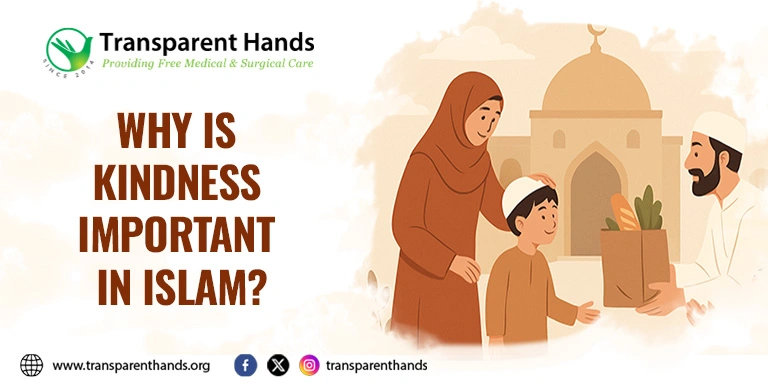
Kindness is one of the most essential qualities encouraged across all human societies. Undoubtedly, human lives are challenging, and without each other’s support and backing, we cannot expect a functional society. The way kindness affects human behavior is truly amazing. According to the World Happiness Report 2025, believing a neighbor would return a lost wallet has a significantly greater impact on a person’s happiness than the prospect of doubling their income.
Islam recognizes this vital human trait and encourages it to the point where kindness becomes a necessity. In this article, we will discuss why kindness is important in Islam and how Shariah urges Muslims to make it an essential part of everyday life.
Show Kindness for Needy Patients
Why is kindness important for Muslims?
Muslims are expected to model their behavior according to the teachings of the Quran. To do that, they must follow the Sunnah of the Prophet Muhammad (ﷺ), who was a person of exceptional kindness. The Prophet’s kindness wasn’t only recognized by the people of His time, but is also mentioned by Allah (SWT) in the Quran.
“And We have not sent you, [O Muhammad], except as a mercy to the worlds. (Surat Al-‘Anbyā’, 21:107)
In another Quranic verse, explain the power of Prophet’s (ﷺ) mercifulness
“So by mercy from Allah, [O Muhammad], you were lenient with them. And if you had been rude [in speech] and harsh in heart, they would have disbanded from about you. So pardon them and ask forgiveness for them and consult them in the matter. And when you have decided, then rely upon Allah . Indeed, Allah loves those who rely [upon Him].” (Surat ‘Āli `Imrān: 3:159)
Therefore, it is safe to conclude that a good practicing Muslim is a kind person who is always keen to lend a helping hand and is always quick to forgive. The Prophet (ﷺ) forgave His worst enemies. Upon bringing the message of peace and love to Taif, the Prophet was confronted by the intolerance and cruelty of the people of Taif. They scorned His message and resorted to violence. Yet, He treated them with kindness and prayed for their salvation. This is just one of the many incidents in which the Prophet (ﷺ) went out of His way to practice compassion and magnanimity.
Your Kindness Uplifts Families
Kindness—a Trait of Allah (SWT)
Another answer to the question “Why is kindness important in Islam?” is that our Creator Himself embodies kindness, as it is one of the key attributes of Allah (SWT).
“Al-Rehman” is one of Allah’s (SWT) names, which means, ‘The most gracious’, or ‘The most Merciful’. Allah is also known as “Ar-Rahim”, “The most merciful”. Al-Rauf is another name of Allah (SWT), which means “The Compassionate”, while Allah (SWT) is also Al-Ghafoor, and Al-Ghaffar, “The great forgiver. All these qualities point to the fact that Allah (SWT) is the source of endless kindness and mercy, and believers must practice mercy to hope for Allah’s (SWT) mercy.
According to the following Hadith, no one can hope for salvation without the mercy of Allah (SWT).
Narrated Abu Huraira: Allah’s Messenger (ﷺ) said, “The deeds of anyone of you will not save you (from the (Hell) Fire).” They said, “Even you (will not be saved by your deeds), O Allah’s Messenger (ﷺ)?” He said, “No, even I (will not be saved) unless and until Allah bestows His Mercy on me. Therefore, do good deeds properly, sincerely and moderately, and worship Allah in the forenoon and in the afternoon and during a part of the night, and always adopt a middle, moderate, regular course whereby you will reach your target (Paradise).”(Sahih al-Bukhari, 6463)
In another hadith, we are told that not only is Allah (SWT) kind, but loves those practice kindness.
It was narrated that `Ali bin Abi Talib (رضي الله عنه) said: The Messenger of Allah (ﷺ) said: “Allah is Kind and loves kindness, and He rewards for kindness in a way that He does not reward for harshness.” (Musnad Ahmad, 902)
Sadaqah, the Practice of Kindness
While practicing kindness in daily life is relatively simple, intuitive, and universal, Islam reinforces this positive behavior through a framework of voluntary giving called Sadaqah. While Zakat is mandatory giving, Sadaqah is given with a kind heart and without any expectation of reward. However, Sadaqah promises many spiritual rewards.
However, before discussing rewards, it is essential to define the scope of Sadaqah, which extends beyond financial assistance to encompass how believers interact with society. Many random acts of kindness are Sadaqah. Therefore, it isn’t charity that Islam promotes, but a complete way of life based on charitable behavior and kindness of the heart.
Hadith About Sadaqah
The following Hadith helps us understand the nature and scope of Sadaqah:
“Every joint of a person must perform a charity each day that the sun rises: to judge justly between two people is a charity. To help a man with his mount, lifting him onto it or hoisting up his belongings onto it, is a charity. And the good word is a charity. And every step that you take towards the prayer is a charity, and removing a harmful object from the road is a charity.” [Al-Bukhari] [Muslim] Hadith 26, 40 Hadith an-Nawawi
As a value, kindness lies at the center of an ideal Islamic life, and believers must understand that it is one of their core duties to practice patience and compassion in their everyday interactions. The best part about emulating this behavior is that it isn’t without rewards.
Allah (SWT) has promised many rewards, for example, according to a Hadith, Sadaqah has the power to avoid calamities
Allah’s Messenger (ﷺ) said, “Give the Sadaqah without delay, for it stands in the way of calamity.” “Razln transmitted it. “ The idea is that it acts as a barrier beyond which calamity cannot pass.” (Mishkat al-Masabih, 1887)
Similarly, the Quran clearly mentions how giving Sadaqah is beneficial for a believer’s afterlife:
“Indeed, the men who practice charity and the women who practice charity and [they who] have loaned Allah a goodly loan – it will be multiplied for them, and they will have a noble reward.” (Surat Al-Ĥadīd, 57:18)
Sadaqah is so powerful that one of its forms, Sadaqah E Jariya, reaps rewards even long after a person dies. All of these acts emanate from the sincerest of intentions to benefit someone—an undeniable act of selflessness and kindness that Allah (SWT) encourages.
Give Sadaqah to Show Your Kindness
Why Donate to Transparent Hands?
You can donate Sadaqah to many causes; however, helping needy patients is one that benefits people immensely. Transparent Hands has been working to provide that relief to the needy Pakistani patients. Since 2014, we have assisted thousands of underprivileged patients with free medical assistance and surgeries. We support a range of surgeries, including cardiac, orthopedic, neurosurgical, gynecological/obstetric, pediatric, general, ENT, urology, and specialized procedures like cochlear implants, along with diagnostic services such as MRI, CT scan, endoscopy, angiography, and treatments for conditions like Hepatitis C, cancer, and disability rehabilitation. With your kindness, we can provide all this care at no cost.
Another important service we provide, with your continued support, is organizing medical camps in low-income areas. These medical camps are managed by professional doctors and paramedics, who provide free medical checkups, medicines, and diagnostic tests. We also arrange free preventive healthcare sessions to educate attendees.
The question “Why is kindness important in Islam?” has many answers. The simple answer is that kindness is a way of life for Muslims. It is an expectation and a duty.
Be kind and donate Zakat, Sadaqah, and other donations to Transparent Hands, as it helps many poor patients get a second chance at life. Donate to us now!




Leave Your Comments