Why Qurbani Matters During Eid ul Adha
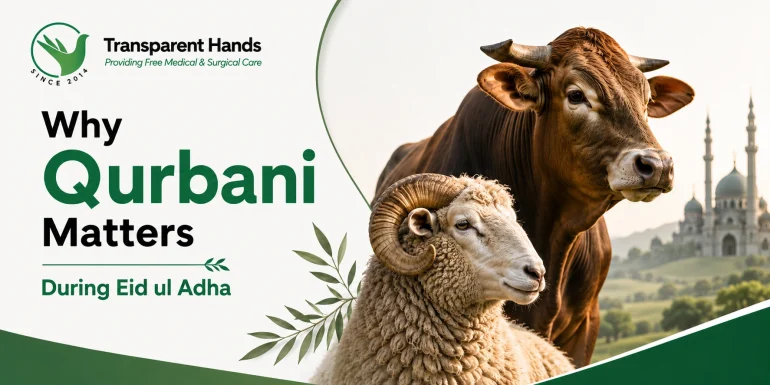
Eid al-Adha is observed by millions of practicing Muslims, making it one of the most significant religious celebrations. At the center of this occasion is Qurbani, the ritual sacrifice of an animal offered to Allah (SWT) in an act of worship, gratitude, and remembrance. Yet in a world where Eid has increasingly come to be associated with new clothes, family gatherings, and social media, the deeper significance of Qurbani can easily get lost.
Understanding why Qurbani matters during Eid ul Adha, what it represents spiritually, and why its distribution to the poor is inseparable from its meaning, is something every Muslim benefits from revisiting before the blessed days arrive.
The Unwavering Faith of Hazrat Ibrahim (AS)
The importance of Qurbani is rooted in one of the most profound acts of faith mentioned in the Quran. The willingness of Hazrat Ibrahim (A.S) to sacrifice his son Hazrat Ismael (A.S) at the command of Allah (SWT) is an exceptional act of selflessness that sets the path of guidance for all believers. The Quran narrates the moment both father and son submitted completely to the divine will:
“And when they had both submitted and he put him down upon his forehead, We called to him, O Abraham, You have fulfilled the vision. Indeed, We thus reward the doers of good. Indeed, this was the clear trial. And We ransomed him with a great sacrifice.” (Surat As-Saffat, 37:103–107)
The ram substituted for Hazrat Ismael (A.S) became the foundation of an annual ritual that Muslims observe. Qurbani on Eid ul Adha is not simply the slaughter of an animal. It is a symbolic renewal of the same faith: a willingness to give up what is precious for the sake of Allah (SWT).
The Obligation That Binds Those Who Can Afford It
According to the Hanafi school of jurisprudence, which governs Islamic practice for the majority of Muslims in Pakistan and South Asia, Qurbani is an obligation on every adult Muslim who possesses wealth equal to or greater than the Nisab. The Quranic command is direct:
“So pray to your Lord and sacrifice [to Him alone].” (Surat Al-Kawthar, 108:2)
The Prophet (ﷺ) reinforced this with a warning that leaves little room for complacency:
“Whoever can afford it, but does not offer a sacrifice, let him not come near our prayer place.” (Sunan Ibn Majah, 3123)
For a Muslim who meets the financial threshold, skipping Qurbani is not recommended. Remember that Qurbani is the most beloved act of worship on the most significant days of the Islamic year.
The Spiritual Meaning That Goes Beyond the Animal
The importance of Qurbani is not found in the physical act of slaughter. The Quran is explicit:
“Their meat will not reach Allah , nor will their blood, but what reaches Him is piety from you. Thus have We subjected them to you that you may glorify Allah for that [to] which He has guided you; and give good tidings to the doers of good.” [(Surat Al-Haj, 22:37)
Qurbani is a test of devotion. By offering something of value, the believer practices the principle of placing nothing above the will of Allah (SWT). The sacrifice symbolizes the willingness to give up ego, desire, and worldly comfort in pursuit of divine nearness. This is why the reward associated with Qurbani is extraordinary:
“The son of Adam does not do any deed on the Day of Sacrifice that is dearer to Allah than shedding blood. It will come on the Day of Resurrection with its horns and cloven hoofs and hair. Its blood is accepted by Allah before it reaches the ground. So be content when you do it.” (Sunan Ibn Majah, 3126)
On a day already filled with divine blessings, Qurbani stands out as the single most beloved act a Muslim can perform.
The Social Dimension: Qurbani and the Poor
The importance of Qurbani extends beyond the individual believer. It has a social function that is built directly into its structure. The traditional division of sacrificial meat into three portions, one for the family, one for relatives and neighbors, and one for those in need, is designed to spread the blessing of Eid to those who cannot celebrate it on their own. The Quran connects Qurbani to feeding the poor:
“Then eat of them and feed the poor and the beggar.” (Surat Al-Haj, 22:28)
In a country like Pakistan, where the majority of the population cannot afford a healthy daily diet according to the World Food Programme, this instruction is very benefitial for the entire society. Millions of families wait for Eid al-Adha without the means to buy meat. The Qurbani system, when working as it should, ensures that wealth and blessing circulate through the community rather than staying only at the tables of those who already have plenty.
Qurbani strengthens community bonds, reduces the sense of exclusion felt by the poorest households, and ensures that the joy of Eid is genuinely shared.
Support Vulnerable Communities with Your Qurbani Through Transparent Hands
As a leading online healthcare crowdfunding platform, Transparent Hands has helped thousands of underprivileged Pakistani patients access the surgical and medical treatments they had been waiting for. We bring that same dedication to our fully Shariah-compliant Qurbani program, conducted with pure intentions, complete transparency, and exceptional diligence. During the past years, the Qurbani meat reached daily-wage workers, members of the transgender community, orphans, families in slums, madrassa students, widows, and elderly residents of old-age homes. With your generous support this year, we can share that blessing with even more deserving families and individuals. Give your Qurbani donation (Fi Sabilillah) through Transparent Hands today!
FAQs
Why is Qurbani performed specifically on Eid al-Adha and not at other times?
Qurbani commemorates the trial of Hazrat Ibrahim (A.S), which is connected to the days of Dhul Hijjah and the rituals of Hajj. The 10th of Dhul Hijjah, the day of Eid al-Adha, is designated by Allah (SWT) as the time for this sacrifice, and no other time carries the same validity.
Does Qurbani need to be performed personally, or can a charity do it?
A charity can perform Qurbani on your behalf as your representative. This is fully permitted in Islam and does not reduce the validity of the sacrifice as long as all Islamic conditions are met.
Why is the distribution of Qurbani meat to the poor considered part of the act’s importance?
The Quran explicitly instructs believers to feed the poor and the beggar from the sacrificial meat. The social dimension of Qurbani is not optional. It is built into the act’s purpose as a means of redistributing blessing through the community.
How many days can Qurbani be performed over?
Qurbani is valid on the 10th, 11th, and 12th of Dhul Hijjah. The sacrifice must begin after the Eid prayer on the 10th and must be completed before sunset on the 12th.
Is Qurbani connected to Hajj?
The days of Qurbani coincide with the final days of Hajj, and the act commemorates the same story of Hazrat Ibrahim (A.S) that is at the heart of the Hajj pilgrimage. However, Qurbani is an obligation for qualifying Muslims worldwide, not only for those performing Hajj.




Leave Your Comments