How Transparent Hands Distributes Qurbani Meat in Pakistan
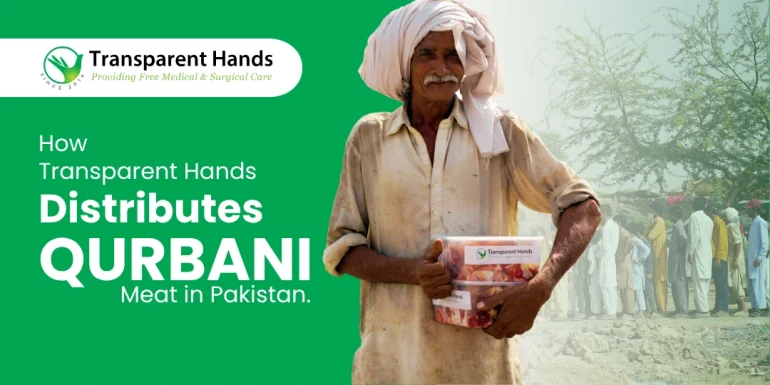
According to the Hanafi School of jurisprudence, Qurbani is an obligation for Muslims. The most convenient and effective way to conduct Qurbani is to donate an equivalent amount to a Shariah-compliant organization like Transparent Hands, which conducts Qurbani on behalf of donors and gifts Qurbani meat to the most deserving communities. Donating for Qurbani is easy. Most donors complete their Qurbani donation within minutes. A few clicks, a payment confirmation, and you are done with your obligation. But what happens after that moment is where the real work begins. According to a study, an estimated 6.8 million animals are sacrificed during Eid ul Adha, generating roughly PKR 839 billion in economic activity, equivalent to about 1 percent of the national GDP.
For a Qurbani to reach the most deserving people, there needs to be a reliable and robust system behind it. Animal sourcing, halal slaughter, hygienic processing, and organized distribution across multiple locations do not happen by chance. They require planning, trained teams, and a commitment to accountability that goes beyond simply collecting donations.
Transparent Hands has built exactly that kind of system. This article will explain the complete process for how Qurbani meat is handled and distributed, from the point of donation to the moment it reaches a deserving family.
Why the Distribution Process Matters for Donors
When you give Qurbani donations, you are trusting an organization to fulfill an important religious duty on your behalf. That trust is not just emotional.
The validity of your Qurbani depends on whether the sacrifice was performed correctly, on the right time and days, using the right method, and whether the meat genuinely reached those who needed it the most. A platform that cannot account for any part of that chain is asking you to give without assurance.
Understanding how Transparent Hands manages this process is not just informative. It is the foundation on which your confidence as a donor should rest.
Step 1: Identifying Deserving Recipients Before Eid
The distribution process at Transparent Hands does not begin on the day of slaughter. It begins weeks, even months in advance, with the planning of operations.
Field teams and partner organizations work together to map out communities where Qurbani meat will be distributed. Each location is assessed based on the level of need, the number of people to be served, and the logistical feasibility of reaching them during Eid.
This pre-identification process ensures that when meat becomes available, there is no delay in getting it to the right hands.
Mr. Raheel Abbas, the director of Transparent Hands, is very particular about choosing the right individuals for Qurbani meat distribution. Mr. Abbas says, “One of our major focus areas is finding the most deserving people for Qurnai meat distribution. We aim at creating an impact, and that isn’t possible without solid groundwork.”
Step 2: Responsible Animal Sourcing
Once the recipient list is in place, Transparent Hands sources animals that meet both religious and quality standards. It is an important procedure because the Shariah law specifies the qualifications for a Qurbani animal. The animal should be healthy and within the age bracket prescribed by Islamic law.
Transparent Hands only purchases animals from verified suppliers and confirms they are healthy, of appropriate age, and free from defects that would invalidate the Qurbani under Islamic guidelines. This step is not treated as a formality. It directly affects whether each donor’s sacrifice is religiously accepted.
Bulk purchasing also allows the organization to manage costs efficiently, which means a greater proportion of each Qurbani donation goes toward feeding people rather than covering inflated procurement expenses.
Step 3: Halal Slaughter by Qualified Individuals
On the designated days of Eid ul Adha, slaughter is carried out by trained individuals who follow proper halal requirements throughout their workflow.
This includes the correct recitations, the use of a sharp instrument to minimize animal discomfort, and full compliance with the conditions required for a Qurbani to be valid. Each sacrifice is performed with the donor’s intention in mind, whether the donation was made for a living family member, a deceased loved one, or specifically designated for orphans or the poor. The names of donors or their nominees (for Qurbani) are also announced. No shortcuts are taken at this stage. The religious integrity of the act is treated as non-negotiable.
Step 4: Hygienic Processing and Packaging
After slaughter, the meat enters a processing and packaging phase that prioritizes hygiene and even distribution. Meat is divided into equal portions, and packaging is done to keep it fresh during transport, particularly important for recipients in locations that may require several hours of travel. Due to extreme heat, it is important to maintain the right temperature to maximize meat preservation. That’s why Transparent Hands uses refrigerated vehicles to keep meat well-preserved. This step is often overlooked in discussions about Qurbani distribution, but it is critical. Poorly handled meat does not just reduce impact. It can cause harm to the very people it was meant to help.
Step 5: On-Ground Distribution to Deserving Families
With processed and packaged meat ready, the distribution teams move to pre-identified locations across Pakistan.
Transparent Hands prioritizes communities that are consistently underserved and overlooked during Eid. We distribute packages among orphans, widows, laborers, people with disabilities, transgender community, madrassa students, old people living in nursing care houses, and families living in slums and low-income regions.
The distribution is carried out systematically, with each location receiving a confirmed quantity of meat based on the number of recipients identified during the pre-Eid planning phase. Teams work through the Eid days to ensure every family on the list is reached within the valid window for Qurbani distribution.
According to the World Bank’s 2025 poverty assessment, 44.7% of Pakistan’s population live below the lower-middle-income poverty threshold of $4.20 per day, with extreme poverty (below $3 per day) affecting 16.5% of the population. For millions of these households, Eid ul Adha may represent the only occasion in the year when they consume fresh meat.
Step 6: Documentation and Donor Reporting
Once distribution is complete, Transparent Hands compiles a full report for every Qurbani donation received.
Donors receive confirmation that their sacrifice was performed, along with details about the date and location of slaughter, the distribution sites where meat was delivered, and the number of families or individuals served. In many cases, this is supported by photographs and field notes from the distribution teams.
This reporting is not an afterthought. It is a core part of what makes Transparent Hands a trustworthy platform for Qurbani donations. Donors who give through a platform that cannot account for where their sacrifice went are giving on faith alone. Transparent Hands replaces that uncertainty with documented evidence.
Who Receives Qurbani Meat Through Transparent Hands?
The recipients of Qurbani meat distributed by Transparent Hands are not selected randomly. Priority is given to those with the least access to food support and the fewest connections to regular charitable giving. We understand that many communities deserve your Qurbani meat packages. Transparent Hands also ensures that the meat remains well-preserved before reaching its recipients. For that purpose, meat is refrigerated in the vehicles that transport it.
According to the World Food Program, the scale of need in Pakistan makes this targeting essential: the World Food Programme reports that Pakistan ranks 109th out of 127 countries on the 2024 Global Hunger Index, with 82 percent of the population unable to afford a healthy diet. These are figures that place Eid meat distribution among the most meaningful nutritional interventions of the year.
How Does Donating to Transparent Hands Make Qurbani Impactful?
Transparent Hands brings form and structure to what is often an uncoordinated effort. Pre-identified recipients, verified slaughter, hygienic processing, organized logistics, and post-distribution reporting combine to create a process where every Qurbani donation is traceable from start to finish.
For donors who want their sacrifice to reach further, feed more, and be accounted for completely, that structure is not just convenient. It is essential.
Conclusion
Qurbani meat is not just food. For a child in an orphanage or a patient in a public hospital ward, it is a tangible sign that someone, somewhere, chose to make their Eid special.
Transparent Hands has built a distribution process that honors the weight of that responsibility. From early recipient identification to final donor reporting, every step is designed to ensure that Qurbani donations are handled with religious integrity, logistical care, and complete transparency.
When you give through a platform that can show you exactly where your sacrifice went, you are not just meeting an obligation. You are giving with the full confidence that your act of worship fulfilled your sacred duty, while the sacrificial meat reaches the place where it is needed the most.
Donate Your Qurbani to Transparent Hands to Maximize Qurbani’s Impact
Transparent Hands is one of Pakistan’s largest and most renowned online crowdfunding platforms for healthcare. Since 2014, thousands of deserving patients across Pakistan have received the treatment they needed.
Our Maternal and Child program has reached thousands of women and children, saving many young lives. We also fund free surgeries, including cardiac, orthopedic, pediatric, neurosurgery, ENT, urology, general surgery, and gynecological and obstetric.
We also arrange free medical camps that provide services of qualified doctors and paramedics to provide free medical checkups, medicines, and diagnostic tests. Thousands of patients benefit from these camps every year in the most low-income regions of Pakistan.
Transparent Hands also runs an efficient, Shariah-compliant Qurbani program. We carry out every Qurbani with full dedication and care. Last year, we reached widows, orphans, transgender communities, families in slums, laborers, madrassa students, and elderly residents of nursing homes. This year, with your support, we can reach many more individuals and families. Let’s make this Eid special by leaving a mark on someone’s life. Make your Qurbani donation now!



Leave Your Comments