How to Pray Istikhara: Step-by-Step Guide
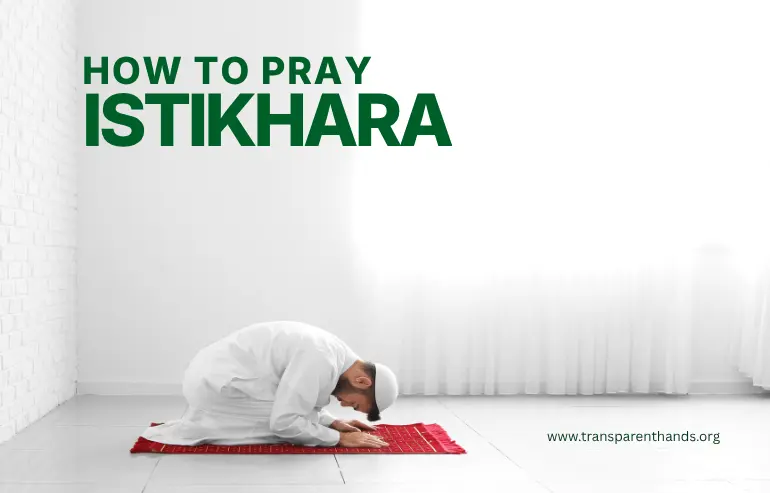
Making decisions can be difficult, especially when they may have serious consequences for a person’s life and well-being. While Allah (SWT) has given humans intellect to make most decisions, sometimes we need more clarity to go through with an important decision. Istikhara is a prescribed process for such situations. While many believers know the spiritual power of Istikhara, few know how to practice it in line with the spirit of the Quran and Hadith. In this blog, we will explore the meaning of Istikhara, its spiritual benefits, and how to pray Istikhara properly to maximize spiritual benefits. We will also address common misconceptions about Istikhara and the most appropriate cases for it. Before explaining that, acknowledge that Istikhara must not be used for every situation. Use it only in selective situations where human intellect and experience may not be enough for sound decision-making. Also, make sure that Istikhara is used for matters that are permissible, Halal, and ethically upright. Here is our Istikhara prayer guide for beginners.
What Is Istikhara?
Istikhara is the process of seeking divine guidance to make sound decisions. While we must always seek help from Allah (SWT) in our daily activities, our decision-making process is sometimes marred by doubt. That is when seeking Allah’s (SWT) guidance becomes important.
Meaning of Istikhara
The word Istikhara comes from Arabic, “Khayr”, which means goodness. Thus, Istikhara is the process of seeking goodness or the best possible outcomes. Istikhara refers to a specific prayer through which believers seek Allah’s (SWT) guidance toward goodness, or the best possible outcome, in a pending decision. Istikhara is deeply rooted in tawakkul, which means complete trust in Allah (SWT). It is also an admission of human limitation and an expression of submission to Allah’s plan for human life.
Why Do Muslims Pray Istikhara?
Muslims pray Istikhara because it allows them to make difficult decisions with confidence that whatever Allah has in store for them is promised to be good. The following Quranic verses clearly state that Allah (SWT) knows best:
“Fighting has been enjoined upon you while it is hateful to you. But perhaps you hate a thing and it is good for you; and perhaps you love a thing and it is bad for you. And Allah Knows, while you know not.’ (Surat Al-Baqarah, 2:216)
By praying Istikhara, we admit to our human limitations and admit that whatever lies ahead in our lives has goodness.
Istikhara in the Sunnah
Istikhara is a very well-established Sunnah of the Prophet (ﷺ). According to the following Hadith, the Prophet (ﷺ) not only taught it, but asked His companions to practice it regularly:
“Narrated Jabir bin `Abdullah: As-Salami: Allah’s Messenger (ﷺ) used to teach his companions to perform the prayer of Istikhara for each and every matter just as he used to teach them the Suras from the Qur’an He used to say, “If anyone of you intends to do some thing, he should offer a two rak`at prayer other than the compulsory prayers, and after finishing it, he should say: O Allah! I consult You, for You have all knowledge, and appeal to You to support me with Your Power and ask for Your Bounty, for You are able to do things while I am not, and You know while I do not; and You are the Knower of the Unseen. O Allah If You know It this matter (name your matter) is good for me both at present and in the future, (or in my religion), in my this life and in the Hereafter, then fulfill it for me and make it easy for me, and then bestow Your Blessings on me in that matter. O Allah! If You know that this matter is not good for me in my religion, in my this life and in my coming Hereafter (or at present or in the future), then divert me from it and choose for me what is good wherever it may be, and make me be pleased with it.” (Sahih al-Bukhari, 7390)
When to Pray Istikhara?
Pray Istikhara when you are genuinely perplexed about a permissible/Halal decision. Istikhara requires you to offer two nafl, or voluntary, prayers, which are not valid in the following three timings: at sunrise (until the sun has risen well above the horizon), at Zenith (when the sun is at its peak), and at sunset (when the sun is setting). The prohibition is clearly stated in the following hadith:
“Abu Sa’id al-Khudri reported Allah’s Messenger (ﷺ) as saying: No prayer is valid after the ‘Asr prayer till the sun sets and no prayer is valid after the dawn prayer till the sun rises.” (Sahih Muslim, 827)
Outside these times, you can pray Istikhara whenever you like. That being said, one of the most virtuous times to pray Istikhara is during the last third of the night. Many references in the Quran and the Hadith establish this time as the most spiritually powerful. The following hadith clearly explains why:
“Narrated Abu Huraira: Allah’s Messenger (ﷺ) (p.b.u.h) said, “Our Lord, the Blessed, the Superior, comes every night down on the nearest Heaven to us when the last third of the night remains, saying: “Is there anyone to invoke Me, so that I may respond to invocation? Is there anyone to ask Me, so that I may grant him his request? Is there anyone seeking My forgiveness, so that I may forgive him?” (Sahih al-Bukhari, 1145)
So one of the most virtuous times to pray Istikhara is the last third of the night. After making your Istikhara prayers, you should pray to Allah (SWT) to make the best choices for you and ease your situation. Waking at this time also gives you an opportunity to pray Tahajud. You can perform your Istikhara after saying your Namaz. Farz Namaz timings change with the sun’s position; therefore, it is advisable to check the timings before praying.
How Many rak‘ahs Are in Istikhara?
Istikhara requires two rak‘ahs, as established by the following Hadith:
“Narrated Jabir: The Prophet (ﷺ) used to teach us the Istikhara for each and every matter as he used to teach us the Suras from the Holy Qur’an. (He used to say), “If anyone of you intends to do something, he should offer a two-rak`at prayer other than the obligatory prayer, and then say: ‘Allahumma inni astakhiruka bi’ilmika, wa astaqdiruka biqudratika, wa as’aluka min fadlika-l-‘azim, fa innaka taqdiru wala aqdiru, wa ta’lamu wala a’lamu, wa anta’allamu-l-ghuyub. Allahumma in kunta ta’lamu anna hadha-lamra khairun li fi dini wa ma’ashi wa ‘aqibati `Amri (or said, fi ‘ajili `Amri wa ajilihi) fa-qdurhu li, Wa in kunta ta’lamu anna ha-dha-l-amra sharrun li fi dini wa ma’ashi wa ‘aqibati `Amri (or said, fi ajili `Amri wa ajilihi) fasrifhu ‘anni was-rifni ‘anhu wa aqdur li alkhaira haithu kana, thumma Raddani bihi,” Then he should mention his matter (need).” (Sahih al-Bukhari, 6382)
So you should pray two rak‘ahs with complete sincerity. After praying Istikhara, take practical steps to pursue the matter rather than waiting for any supernatural signs. Don’t rush into another Istikhara for the same matter out of anxiety. However, if the situation remains vague even after the first Istikhara, and no practical sign appears, you may repeat it.
How to Pray Istikhara?
Before praying Istikhara, make sure you pray at the right time. Follow these Istikhara prayer steps:
Make the Intention (Niyyah)
Almost all Islamic rituals require you to make an intention, or Niyyah, before proceeding. Make the Niyyah to pray two rak‘ahs of Istikhara for the sake of Allah (SWT). You don’t have to say the words aloud. Making the Niyyah in your heart will suffice.
Performing Ablution
Before starting your prayers, make sure that you have performed ablution thoroughly. Cleanse yourself properly before making the spiritual connection through your prayer.
Find a Clean and Pure Place
To perform your rak‘ahs, make sure you have a clean, quiet place where you can concentrate and make a spiritual connection. Also, make sure you face the Qibla before starting your rak‘ahs.
Pray Two rak‘ahs of voluntary prayer
Start praying the two rak‘ahs exactly in the manner that Salah is performed. At the completion of the prayers, make sure to raise your hands with complete humility and begin your Istikhara dua. When you reach “”hadhal amra” part in the dua, state your situation clearly.
Say the Istikhara Dua
Once you have completed your Dua, relax and trust Allah (SWT), for He is the best planner. Just wait and see if your situation eases and moves toward what your heart might be inclined toward. Seeing a dream about the situation is rare, and you shouldn’t expect it. From here onwards, trust Allah (SWT) and know that whatever outcomes that He presents are the best for you.
What Is the Istikhara Dua?
The following is the Istikhara dua in Arabic and its translation:
Istikhara Dua in Arabic
ٱللَّٰهُمَّ إِنِّي أَسْتَخِيرُكَ بِعِلْمِكَ، وَأَسْتَقْدِرُكَ بِقُدْرَتِكَ، وَأَسْأَلُكَ مِنْ فَضْلِكَ ٱلْعَظِيمِ، فَإِنَّكَ تَقْدِرُ وَلَا أَقْدِرُ، وَتَعْلَمُ وَلَا أَعْلَمُ، وَأَنْتَ عَلَّامُ ٱلْغُيُوبِ. ٱللَّٰهُمَّ إِنْ كُنْتَ تَعْلَمُ أَنَّ هَٰذَا ٱلْأَمْرَ (هٰذَا الأَمْر) — وَتُسَمِّي حَاجَتَكَ — خَيْرٌ لِي فِي دِينِي وَمَعَاشِي وَعَاقِبَةِ أَمْرِي، فَٱقْدُرْهُ لِي وَيَسِّرْهُ لِي ثُمَّ بَارِكْ لِي فِيهِ. وَإِنْ كُنْتَ تَعْلَمُ أَنَّ هَٰذَا ٱلْأَمْرَ شَرٌّ لِي فِي دِينِي وَمَعَاشِي وَعَاقِبَةِ أَمْرِي، فَٱصْرِفْهُ عَنِّي وَٱصْرِفْنِي عَنْهُ، وَٱقْدُرْ لِيَ ٱلْخَيْرَ حَيْثُ كَانَ ثُمَّ أَرْضِنِي بِهِ
Istikhara Dua’s Translation (in English)
“O Allah, I seek Your guidance through Your knowledge, and I seek Your power through Your power, and I ask You for Your great bounty. For You are capable while I am not, You know while I do not, and You are the Knower of the unseen. O Allah, if You know this matter (name your specific matter) is good for me in my religion, my livelihood, and the outcome of my affairs, then decree it for me, make it easy for me, and bless me in it. But if You know this matter is bad for me in my religion, my livelihood, and the outcome of my affairs, then turn it away from me and turn me away from it, and decree for me what is good wherever it may be, and make me content with it.”
Note: The words “hadhal amra” (this matter) and “tusammi haajatika” (name your need) indicate the point where you specifically start explaining your situation to Allah (SWT). You can do so in your own language.
Can You Perform Istikhara for Marriage?
Yes, performing Istikhara for marriage is a common practice. You can pray Istikhara for marriage, but make sure that you have already done the other necessary groundwork. You must learn about a potential spouse’s character, religiosity, and family background before performing Istikhara. In this case, Istikhara should be the last stage, if needed.
Can You Perform Istikhara for Any Decision?
You may perform Istikhara for a decision that involves Halal outcomes. Shariah rules supersede everything. Therefore, you can perform Istikhara in situations such as choosing a spouse, accepting a job, starting a business, choosing a place to live, etc. These are situations where multiple paths exist and can lead to different outcomes that can deeply impact a person’s life.
Remember that matters that are completely forbidden by the Shariah must be avoided. Istikhara doesn’t apply to such matters. By the same token, matters that are deemed obligatory by the Shariah must be followed, no matter what. Trivial matters should also be overlooked for Istikhara. Remember that Allah (SWT) has given us intellect to make most of our routine decisions.
Common Misconceptions About Istikhara
The following are some misconceptions about Istikhara that have no basis in the Shariah,
- Dreams are required in Istikhara. That’s the biggest misconception about Istikhara. Dreams aren’t required in Istikhara, and they aren’t a reliable indicator. You need to see whether pursuing a particular choice is getting easier or harder.
- A certain feeling of ease might occur after Istikhara, but what you should see is whether pursuing a particular matter is getting easier or harder.
- Istikhara must be conducted many times. This is another widespread misconception to avoid.
- Istikhara can be used for fortune-telling. Many charlatans use Istikhara as if it were a fortune-telling mechanism. This isn’t the case, and it is an un-Islamic practice.
- Someone else can perform Istikhara for me. Ideally speaking, you should do your Istikhara yourself.
- Istikhara always guarantees my favored outcomes. That is not true. Remember that Allah (SWT) knows best and His wisdom is infinite. Don’t always expect your favored choices. Rather, keep believing in Allah’s (SWT) plans.
Conclusion
Istikhara is a beautiful way to make a spiritual connection with Allah (SWT) in significant matters like choosing a spouse, making a business investment, choosing a place to live, etc. The Istikhara method is simple and easy to perform. It only requires two rak‘ahs and a dua. Praying Istikhara in the third of the night may help you develop a strong spiritual connection, as it is a sacred time, according to a hadith. Remember that Istikhara should only be performed in Halal situations and after due diligence. Don’t look for miraculous signs after Istikhara. Rather, just see whether your situation eases or more hurdles come up, and take practical steps towards reaching a solution. Also remember that Istikhara is not a substitute for regular rational decision-making. Rather, it is a spiritual support that must be used wisely. One widespread misconception about Istikhara is that it always results in dreams. Many soothsayers use Istikhara wrongfully. Beware of Charlatans, and focus on improving your relationship with Allah (SWT).




Leave Your Comments